Insights
The Link Under Your Best Video Is Probably Sending Buyers to a Dead End
I audited a professional services channel recently. The content was solid. The Shorts were doing their job. And every single long-form video sent viewers to the same place: the website homepage.
That one habit was quietly costing them clients.
What is a call to action on a YouTube video?
A call to action is the prompt that tells a viewer what to do next - spoken on camera, shown on screen, or written as a link in the description. On most channels it asks for a subscribe or a like.
On a business channel, that is a waste of the best real estate you own. The person watching your long-form video to the end is the warmest lead your marketing will produce this week. Asking them to subscribe is asking them for a favour. The question worth asking is where you send them instead.
Where should your YouTube call to action send people?
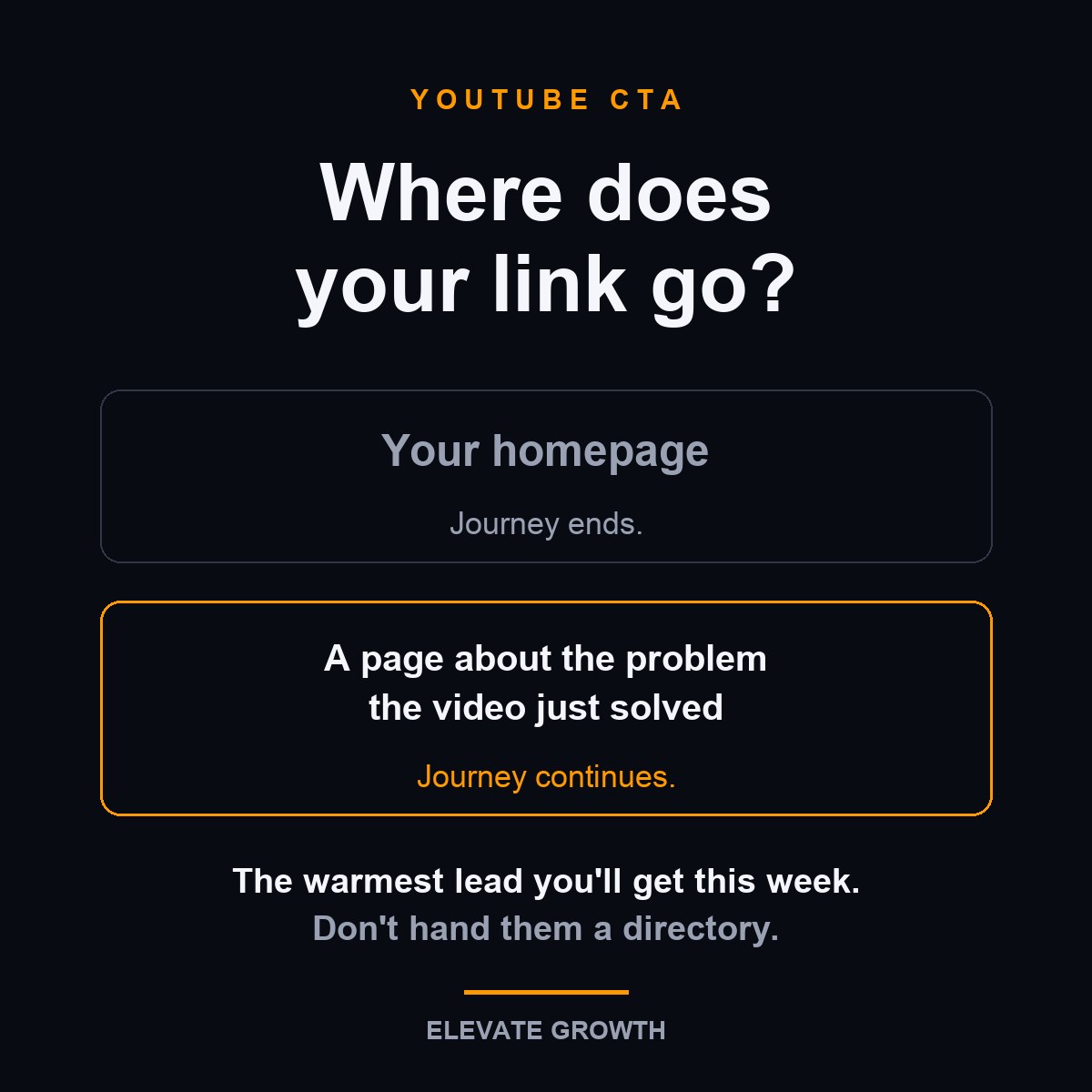
To a page built for the exact problem the video just discussed - not to your homepage.
Think about what actually happens. Someone watches eight minutes on a topic they genuinely care about. They are warm. They want to go deeper. They click your link and land on your website's front door: a hero image, a nav bar, six services, a company mission, and no trace of the thing they just spent eight minutes on.
So they scan. Then they leave. The session ends, and the moment they were ready to act is gone.
A homepage is a directory. It answers "who are you?" for someone who does not know you. But your viewer already knows who you are - they just watched you for eight minutes. They have a different question, and the homepage does not answer it.
Why does the homepage end the journey?
Because it makes the viewer do the work of finding their own next step, at exactly the moment their attention is at its most fragile.
It helps to be clear about what each format is for. Shorts are discovery - they get you found by people who have never heard of you. Long-form is where trust is built and where somebody privately decides you might be the person to help. Those are different jobs, and the CTA under a long-form video is the only bridge between the second one and your business.
A big channel makes that split easy to see. Across the 1,723 videos behind Simon Squibb's YouTube strategy, four in five Shorts descriptions carry no link at all, while the median long-form description carries four. His most watched upload is a 56-second Short with 43 million views and it sells nothing, because the platform gives it nowhere to sell to. The long videos do the commercial work.
Where you put the ask matters as much as where the link points. Mel Robbins pitched a six-month coaching programme inside a live Q&A, on a channel with six million subscribers. That video has 6,951 views, and her livestreams run a median of 30,370 views against 329,401 for her uploads. The offer went out on the smallest audience she has. If you're asking for something, put the ask inside the format your viewers already turn up for.
Sending that person to a homepage is like ending a good first meeting by handing someone your company brochure and walking off.
What should the page you send them to actually do?
Continue the conversation the video started. In practice that means:
- The headline names the same problem the video named, in the same words
- One action is available, not six - a call, an enquiry form, a download
- The proof on the page is relevant to that problem specifically, not your general credentials
- Nothing above the fold asks the visitor to choose a department
You do not need a page per video. Most service businesses need three or four, one per core problem they solve, with each video pointing at the one that matches. That is a weekend of work, not a rebuild.
How do you know whether your call to action is working?
Give each video its own tracked link, so when an enquiry lands you can tell which video sent it. That single habit is what separates a channel you can report on from one you can only guess at, and it is worth reading how YouTube conversion tracking changes which of your videos looks successful.
Most owners skip it, and it is what turns an opinion into a number. Without it, you know the channel produced 40,000 views and eleven enquiries, and nobody can connect the two. With it, you find out that the video with 900 views produced four of those enquiries and the one with 22,000 views produced none - which changes what you film next.
The link is the second half of the job. The first half is choosing a topic your buyers were already searching for, because a perfect landing page under a video nobody wanted still returns nothing. Two things worth checking before you change anything else:
- Whether your CTA link is actually clickable at all - long-form descriptions need advanced features enabled on the channel, and Shorts descriptions do not make links clickable
- Where your current links point, across your ten most recent videos - on most business channels the honest answer is "the homepage, every time"
What to change first
Take your best-performing long-form video, the one that pulls the right kind of viewer. Write one page that continues its conversation. Point that video's description and end screen at the new page with a tracked link. Leave everything else alone for a month, then look at what came in.
The purpose of a business channel is not views. It is being found by the right person at the moment they are ready - and then giving them somewhere to go. Working out which videos are doing that, where the leak is, and what each one actually returned is the monthly job our YouTube channel management service exists to do.

Meet Stewart
Stewart Read
Fractional YouTube Growth Strategist
I've run YouTube channel management for 8-figure businesses, turning their channels into reliable sources of leads, clients and measurable revenue rather than views alone.
Using a class-leading suite of channel analysis tools he built himself, he pinpoints exactly what makes your audience click, watch, and convert - then turns those findings into videos that bring buyers to your business.
Channel Intelligence
The monthly service behind this analysis. A written briefing on what your channel returned to the business, a video walkthrough of the findings I record myself, and a plan for the videos to make next.
See how Channel Intelligence works